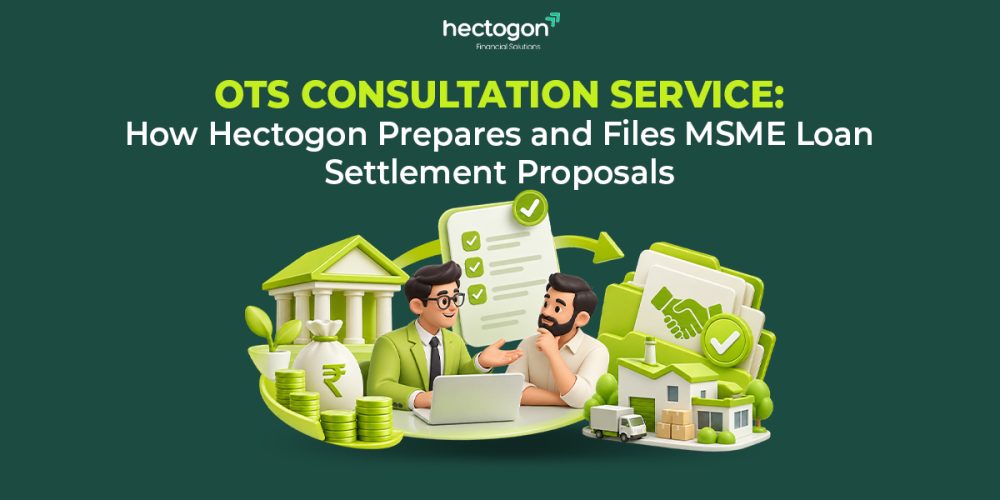





Hectogon’s ots consultation service india covers the full path from a rejected or untested OTS proposal to a filed submission built against the specific bank’s own completeness requirements. The service exists because most OTS rejections happen for procedural reasons unrelated to whether the settlement amount itself is reasonable, and a chartered accountant or generic advisor preparing a proposal without checking it against the bank’s actual documentation checklist is the most common reason a first submission comes back rejected.
Borrowers usually reach Hectogon after this has already happened once. A CA has prepared a proposal in good faith, it has been returned for documentation reasons the rejection letter rarely explains clearly, and the borrower is left without a clear next step or a sense of which specific requirement was missed. What follows describes each stage of the service, the documentation it produces, and the practical timelines involved, so a borrower or guarantor considering an OTS filing knows what the engagement actually covers before the first consultation.
What the service includes
Hectogon’s ots consultant india engagement runs across four stages, each addressing a specific point where OTS proposals commonly fail.
Documentation audit. Before any proposal is drafted, Hectogon reviews the account’s current NPA classification and classification date, the full correspondence history with the bank, and a breakdown of the outstanding amount as the bank has stated it. Where a proposal has already been submitted and rejected once, this stage specifically identifies which procedural requirement caused the rejection, rather than starting the settlement negotiation over from the beginning without knowing what went wrong the first time.
Eligibility assessment. Every bank operates its own board-approved OTS policy within the RBI’s compromise settlement framework, and eligibility criteria, including how long the account must have been classified NPA and which settlement floors apply, differ by bank and by the account’s specific asset classification. This stage confirms which of the bank’s schemes actually applies to the account before any proposal is drafted against the wrong scheme’s requirements.
Proposal preparation. Hectogon prepares the full annexure set a bank’s recovery department expects: audited financial statements certified with a valid UDIN, a networth certificate for every co-borrower and guarantor individually, a current market valuation of pledged security from a SEBI-registered or bank-approved valuer, and the OTS proposal letter itself, including the settlement amount computation and proposed payment timeline, cross-checked against the specific bank’s OTS policy requirements before submission.
Filing and follow-up. Hectogon submits the completed proposal to the bank’s recovery department and follows the file through the review and sanction process, including responding to any queries the recovery committee raises before issuing a sanction letter.
What documentation Hectogon prepares
A complete OTS filing through Hectogon includes audited financial statements for the last 2 to 3 years, each certified by a Chartered Accountant with a valid UDIN reference the bank can verify; an individual networth certificate for every co-borrower and guarantor on the facility; a current market valuation of all pledged security from a SEBI-registered or bank-approved valuer; the OTS proposal letter itself, with the settlement computation and payment timeline set out clearly; and supporting correspondence that references the specific bank OTS scheme the proposal is filed under. Every document in this set is checked against that bank’s own policy requirements before the file is submitted, rather than assembled generically and adjusted only if the bank raises an objection.
How long the process takes
In Hectogon’s experience, document preparation and proposal filing typically takes 3 to 6 weeks from the first consultation, depending largely on how complete the client’s own documents are at the outset. Once filed, banks typically take 60 to 120 days to review and sanction proposals for accounts below Rs 2 crore, which usually fall within branch committee authority, and 120 to 180 days for larger accounts requiring zonal or head office committee approval. Taken together, this puts total time from first consultation to sanction letter at roughly 4 to 9 months in most cases, though these figures are indicative based on Hectogon’s own case experience and are not a guaranteed timeline for any specific account.
Which banks and account types this service covers
Hectogon’s msme loan settlement advisor service is built around MSME borrowers and guarantors with NPA accounts across the public and private sector banks that maintain board-approved OTS policies under the RBI’s compromise settlement framework. Because each bank’s specific scheme differs in its eligibility criteria and documentation expectations, the eligibility assessment stage described above confirms which bank-specific scheme applies before any proposal work begins, rather than assuming a single generic OTS process applies uniformly across lenders.
This account-specific approach also extends to how the service handles guarantors and co-borrowers, who are frequently a second point of failure in proposals prepared without dedicated OTS experience. A proposal is treated as incomplete by most recovery departments if even one guarantor’s individual networth certificate is missing, regardless of how thorough the primary borrower’s own documentation is, and Hectogon’s proposal preparation stage confirms every guarantor’s documentation is in place before the file is submitted rather than after a bank raises the gap as a rejection ground.
Why sequencing matters for a npa ots consultant engagement
Most generic debt-settlement advisors and CA-led OTS assistance treat the engagement as primarily a negotiation exercise: agreeing on a settlement percentage, framing the hardship case, and presenting the business’s repayment capacity. That work matters, but it addresses the second stage of a bank’s review, the commercial assessment, which a recovery committee only reaches once a proposal has already cleared the bank’s completeness check. An advisor focused on the negotiation itself, without first confirming which specific documents that bank’s recovery department expects and in what form, is solving the second problem before checking whether the first one exists.
This is the specific gap a documentation-first npa ots consultant engagement is built to close. A borrower whose account has already been classified NPA is working against the clock on multiple fronts at once, the underlying debt, any parallel SARFAESI notice timeline, and the bank’s own internal review calendar, and a rejected first proposal costs weeks or months that a borrower in this position often cannot easily recover. Confirming the account’s eligibility under the correct bank-specific scheme, and assembling every required annexure in the form that bank’s recovery department will actually accept, before the commercial negotiation begins, is what separates a proposal that reaches the recovery committee on the first attempt from one that is returned before anyone evaluates the settlement figure at all.
What happens when a first proposal has already been rejected
A meaningful share of borrowers reach Hectogon after a first OTS proposal, prepared by a CA or another advisor, has already come back rejected, often with a rejection letter that states “incomplete documentation” without specifying which requirement was actually missed. In this situation, the documentation audit stage described above is not a generic starting point; it specifically works backward from the rejection to identify which annexure, certification, or procedural element caused the return, so that a second submission does not simply repeat the same gap in different language.
This distinction matters because a second rejection on the same procedural grounds carries more weight with a bank’s recovery department than a first one did, making the account’s standing for any future negotiation meaningfully weaker. Borrowers who have already had one proposal rejected typically have the most to gain from confirming exactly what went wrong before resubmitting, rather than assuming the same documentation, resubmitted with a revised settlement figure, will produce a different result.
What Hectogon charges
Fees for OTS consultation are discussed at the initial consultation and depend on the outstanding loan amount, the complexity of the account, and the number of co-borrowers and guarantors involved. There is no fixed published rate for this one time settlement service, since the scope of documentation work varies meaningfully between a straightforward single-borrower account and a multi-guarantor facility with a prior rejected proposal to review first.
Why a documentation-first approach matters for a bank loan settlement india
The distinguishing feature of Hectogon’s approach is sequencing: the documentation audit and eligibility assessment happen before proposal drafting begins, not after a first submission is rejected. This matters because a bank’s recovery department evaluates completeness before it evaluates the commercial reasonableness of a settlement offer, and a proposal that fails on completeness never reaches the stage where the offered amount is actually considered. Borrowers who have already had one proposal rejected, whether prepared by a CA, a generic advisor, or filed without professional assistance, typically benefit most from this sequencing, since it identifies the specific procedural gap that caused the earlier rejection before a second attempt repeats the same mistake.
The same sequencing applies to a fresh account that has not yet had any proposal submitted. Even where no prior rejection exists, confirming eligibility and assembling the complete documentation set before drafting the settlement proposal itself reduces the number of rounds a proposal needs to go through before reaching sanction, which matters directly given how much of the total 4 to 9 month timeline sits with the bank’s own internal review process once a complete file has actually been submitted.
Frequently asked questions
What does Hectogon’s OTS consultation service include?
Four stages: an initial documentation audit of the account’s classification and correspondence history, an eligibility assessment to confirm which bank-specific OTS scheme applies, proposal preparation covering all required annexures, and filing with follow-up through the bank’s review and sanction process. This is general information about service scope; consult Hectogon’s team to discuss your specific situation.
How long does the process take from first consultation to OTS proposal filing?
Document preparation and filing typically takes 3 to 6 weeks from the first consultation, depending on document completeness. Banks then typically take 60 to 120 days for accounts below Rs 2 crore and 120 to 180 days for larger accounts, putting total time to sanction at roughly 4 to 9 months. These timelines are indicative and not guaranteed outcomes.
What documentation does Hectogon prepare for an OTS proposal?
Audited financial statements for 2 to 3 years with a valid UDIN, individual networth certificates for co-borrowers and guarantors, a current security valuation from a SEBI-registered or bank-approved valuer, the proposal letter with settlement computation, and correspondence referencing the applicable bank OTS scheme, all checked against that bank’s specific policy before filing.
What does Hectogon charge for OTS consultation and service?
Fees depend on the outstanding loan amount, account complexity, and the number of co-borrowers and guarantors involved, and are discussed at the initial consultation rather than published as a fixed rate. This content is for general informational purposes and does not constitute legal or financial advice.