



An ibc section 12a withdrawal requires the approval of not less than 90 percent of the Committee of Creditors by voting share, the single most restrictive threshold anywhere in the IBC framework. A promoter who has secured a buyer, negotiated a settlement figure, and believes the matter is resolved often discovers that the legal availability of Section 12A and the practical achievability of that 90 percent vote are two very different things, and the gap between them is usually where a withdrawal strategy actually succeeds or fails.
This gap has widened, not narrowed, with recent changes to the law. As of May 26, 2026, Section 12A operates under a materially tighter framework than the version most existing commentary describes, and understanding both the current eligibility window and the voting mathematics is necessary before any withdrawal strategy is built.
What Section 12A allows, and when it is available now
Section 12A was inserted into the Insolvency and Bankruptcy Code, 2016 by the Insolvency and Bankruptcy Code (Second Amendment) Act, 2018, with retrospective effect from June 6, 2018, following the Supreme Court’s direction in Uttara Foods and Feeds Pvt. Ltd. v. Mona Pharmachem that a formal withdrawal mechanism was needed. The provision allows the Adjudicating Authority to permit withdrawal of an application admitted under Section 7, 9, or 10, on an application made with the approval of not less than 90 percent of the Committee of Creditors by voting share, following the procedure set out in Regulation 30A of the IBBI (Insolvency Resolution Process for Corporate Persons) Regulations, 2016.
The Insolvency and Bankruptcy Code (Amendment) Act, 2026, in force from May 26, 2026, substituted Section 12A and narrowed its availability. The 90 percent threshold itself is unchanged. What changed is the timing: withdrawal is now permitted only after the Committee of Creditors has been constituted and before the first invitation for resolution plans is issued, closing both the earlier pre-CoC withdrawal route and the later window that had allowed withdrawal even after resolution plan solicitation had begun. The Adjudicating Authority must now dispose of a Section 12A application within 30 days, recording reasons if it takes longer. For a corporate debtor and promoter evaluating this route today, the practical consequence is a narrower calendar window than earlier guidance suggests, bounded on one side by CoC formation and on the other by the Form G invitation, rather than the more flexible timeline available before May 2026.
Why 90 percent is harder than it sounds
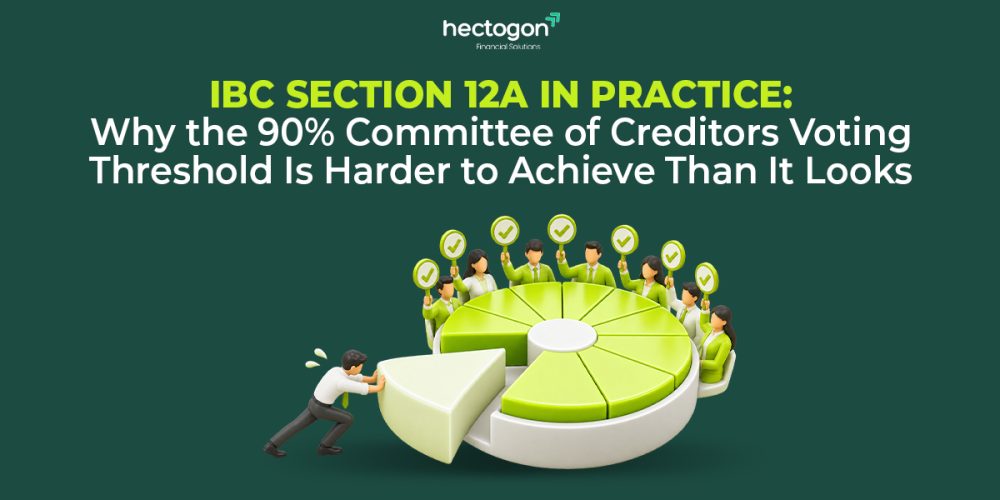
A 90 percent threshold sounds achievable in the abstract; in most real CIRP cases, it is the hardest number in the Code to reach. A single creditor holding more than 10 percent of total financial debt by voting share can block the application outright, and most mid-sized and large CIRPs have a capital structure where this is not a remote risk. A typical case with a lead bank holding 40 to 60 percent of debt and two to four smaller financial creditors holding the remainder requires the participation of nearly every creditor in the room, not just the largest one. The lead bank’s support is usually necessary, but on its own it is rarely sufficient.
This structural feature is why committee of creditors ibc dynamics matter more for a Section 12A strategy than for almost any other stage of a CIRP. Mapping each creditor’s voting share and anticipated objections before filing, rather than after a first attempt fails, is the difference between a withdrawal application built around addressable objections and one that surfaces them for the first time at the CoC meeting where the vote actually happens. Objections commonly turn on the settlement amount relative to the estimated realisable value of the corporate debtor’s assets, rather than on the principle of withdrawal itself, which means a blocking creditor’s concern is frequently addressable through a revised payment structure rather than through legal argument.
Voting share itself is calculated with reference to the financial debt owed to each financial creditor as a proportion of the total financial debt admitted in the CIRP, a figure the Resolution Professional determines and certifies as part of the withdrawal application under Regulation 30A. This is worth confirming independently before relying on it: disputes over whether a particular creditor’s claim was correctly admitted, or whether a specific facility should be counted as financial or operational debt, can shift the voting-share arithmetic in ways that matter enormously at a 90 percent threshold, where a small recalculation can be the difference between clearing the bar and falling short of it.
Recent IBBI data gives a sense of scale: by June 30, 2025, roughly 1,191 CIRPs, close to 14 percent of all admitted cases, had been withdrawn under Section 12A, the majority initiated by operational creditors. That volume reflects genuine, achievable use of the provision, but it also reflects a filtered population: cases that reach a completed 90 percent vote are, almost by definition, cases where the voting-share mathematics happened to work out, which is a different thing from Section 12A being routinely easy to use across the full range of CIRPs where a settlement is commercially sensible.
What happens when a blocking creditor will not approve
If one or more creditors holding more than 10 percent of voting share decline to approve, the CIRP continues, and the applicant cannot compel that creditor’s vote. Three realistic paths exist from that point.
Renegotiate the settlement terms with the specific blocking creditor. Since objections most often concern the adequacy of the settlement relative to realisable asset value, a revised structure, whether in quantum, payment timeline, or security for deferred payments, addresses the actual commercial concern rather than treating the block as a fixed obstacle.
Approach the Adjudicating Authority on narrow procedural grounds. This route has narrowed since GLAS Trust Company LLC v. Byju Raveendran & Ors. (2024), in which the Supreme Court held that CIRP proceedings, once admitted, bind all creditors collectively and that withdrawal applications must proceed through the Resolution Professional under Section 12A and Regulation 30A, not through NCLT or NCLAT’s inherent powers under Rule 11 or the Supreme Court’s own Article 142 power as an alternative route around the statutory process. This does not eliminate procedural challenges to a CoC vote conducted in genuinely bad faith, but it forecloses using inherent powers to bypass the CoC’s 90 percent requirement altogether, and any argument along these lines should be built with that boundary clearly in view rather than treated as a general-purpose fallback.
Withdraw and refile after further negotiation, if the CIRP timeline allows. A rejected application does not permanently foreclose a later one, provided the case remains within the narrower post-2026 filing window and the CIRP’s overall statutory timeline has not run out.
Why courts will not simply override a reluctant creditor
A recurring question from promoters is whether a court can simply direct a holdout creditor to approve an ibc cirp withdrawal. The answer, consistently, is no. In Vallal RCK v. Siva Industries and Holdings Limited & Ors., Civil Appeal Nos. 1811-1812 of 2022, decided by the Supreme Court on June 3, 2022, the Court held that once 90 percent or more of the Committee of Creditors approves a settlement and withdrawal in the exercise of its commercial wisdom, neither the NCLT nor the NCLAT can sit in appeal over that judgment, reaffirming the principle of minimal judicial interference in IBC proceedings established in Arun Kumar Jagatramka v. Jindal Steel and Power Limited. This is the specific extension, to a Section 12A withdrawal scenario, of the broader commercial-wisdom doctrine the Supreme Court set out in Committee of Creditors of Essar Steel India Ltd. v. Satish Kumar Gupta, (2020) 8 SCC 531, which held that the CoC’s commercial assessment is not subject to substitution by judicial reassessment.
The inverse of this principle matters just as much for a blocked applicant: if courts will not override a CoC that approves a settlement, they are equally reluctant to override a CoC that declines one. Judicial intervention remains available only where a CoC’s refusal is demonstrably arbitrary or where the vote itself suffered a genuine procedural irregularity, not simply because the applicant disagrees with the commercial outcome. This is a narrow ground, and it should be approached as an exception for genuinely defective votes, not as a routine second attempt at persuasion after a commercial negotiation has failed.
What an NCLAT appeal actually involves if the application is rejected
Where the NCLT rejects a properly filed ibc 12a application, whether for a technical deficiency in the filing or a disputed question about whether the 90 percent threshold was genuinely met, the applicant’s recourse is an appeal to the NCLAT under Section 61 of the Code, ordinarily within 30 days of the NCLT’s order. An nclat ibc appeal in this context is not a fresh opportunity to relitigate the CoC’s commercial judgment; consistent with Vallal RCK and the broader commercial-wisdom doctrine, the NCLAT’s review is confined to whether the statutory procedure under Section 12A and Regulation 30A was correctly followed; questions such as whether the voting share calculation was accurate, whether the Resolution Professional correctly routed the application, and whether the CoC meeting itself complied with the required notice and quorum requirements.
This distinction matters for how an appeal should be framed. An appeal built around “the settlement should have been approved because it was commercially reasonable” is unlikely to succeed, since that argument asks the NCLAT to do exactly what Vallal RCK says it cannot: second-guess the CoC’s commercial assessment. An appeal built around a specific, demonstrable procedural defect, an inaccurate voting share calculation that would have crossed 90 percent had it been correctly computed, for example, occupies genuinely different and more viable ground.
The current climate for IBC settlement more broadly
The tightening of Section 12A’s timing window is part of a broader shift in how ibc settlement 2026 strategy needs to be approached compared to the framework that existed even a year earlier. The 2026 Amendment Act’s changes were driven substantially by GLAS Trust Company LLC v. Byju Raveendran, a case in which a settlement negotiated between a corporate debtor and one creditor, routed around the CoC entirely through an attempt to use NCLAT’s inherent powers, was successfully challenged by a separate financial creditor with a far larger exposure who had been excluded from that settlement’s negotiation. The Supreme Court’s response, that CIRP proceedings bind all creditors collectively once admitted, and Parliament’s response, narrowing the statutory withdrawal window itself, both point in the same direction: settlement-based exits from CIRP are still available, but the margin for approaching them informally, or as a negotiation between the applicant and a single cooperative creditor, has narrowed considerably. A withdrawal strategy that does not account for every creditor with a meaningful voting share from the outset is a materially riskier strategy under the current framework than it would have been in 2023 or 2024.
What this means for structuring a Section 12A strategy
The practical sequence that tends to work is the reverse of how many promoters initially approach this: build the creditor map and identify likely blockers before filing, rather than filing first and discovering the 10-percent-plus objector during the CoC vote. Understanding each creditor’s specific concern, whether it is settlement adequacy, payment security, or a position on the corporate debtor’s ongoing viability, allows a settlement structure to be shaped around addressable objections from the outset. Given the narrower post-May 2026 timing window between CoC constitution and the first resolution plan invitation, this mapping exercise also now has less calendar room to work within than it did before the amendment, which makes starting it early, rather than after an initial vote fails, considerably more important than it used to be.
This front-loaded approach also changes how a settlement offer itself should be constructed. Rather than proposing a single, fixed settlement figure to the full CoC and hoping it clears 90 percent, a more resilient strategy involves informal soundings with each meaningfully sized creditor before the formal vote, structuring the offer, or a menu of payment timing options, around what is known in advance to be acceptable to the specific creditors whose votes are actually in question. A settlement that comfortably satisfies a lead bank holding 55 percent of voting share but ignores the concerns of a smaller creditor holding 12 percent is not a strong settlement under Section 12A’s mathematics, however commercially sound it may look from the applicant’s side of the table; it is a settlement that has not yet done the work needed to clear the threshold that actually governs whether withdrawal happens at all.
None of this guarantees a particular creditor’s vote, and no strategy converts a genuinely uncooperative holdout into an approving one through documentation alone. What a properly sequenced approach does is ensure that when a creditor declines to approve, the reason is a considered commercial position rather than a surprise raised for the first time at the vote itself, which is the difference between a blocked application that can still be renegotiated and one that has effectively ended the withdrawal route for that CIRP.
Frequently asked questions
What is IBC Section 12A and when can a corporate debtor use it?
Section 12A allows withdrawal of an admitted CIRP application with approval from not less than 90 percent of the CoC by voting share. Since the 2026 amendment took effect May 26, 2026, withdrawal is permitted only after the CoC is constituted and before the first resolution plan invitation, per amended Section 12A and Regulation 30A.
What does the 90 percent CoC threshold actually mean in practice?
A single creditor holding more than 10 percent of voting share can block approval outright. In typical cases with a lead bank holding 40 to 60 percent and several smaller creditors holding the rest, reaching 90 percent requires near-universal creditor participation, not just the largest creditor’s support, which is usually necessary but not sufficient on its own.
What happens if a creditor with more than 10 percent voting share blocks Section 12A?
The CIRP continues and the applicant cannot compel the vote. Options include renegotiating settlement terms with the specific objector, a narrow procedural challenge to a genuinely bad-faith CoC vote, or withdrawing and refiling after further negotiation if the CIRP timeline still permits it.
Can NCLT override a CoC that refuses to approve a Section 12A application?
Generally no. Courts have held the CoC’s commercial wisdom is not subject to judicial substitution in either direction, per Vallal RCK v. Siva Industries and Holdings Limited (2022) and Essar Steel (2020) 8 SCC 531. Override is reserved for demonstrably arbitrary refusals or genuine procedural defects in the vote itself, not commercial disagreement.